서랍장 5단중에 3단 수리
회사에서 드릴 가져와서 망정... 인가? 아니면 더 힘들었나 모르겠지만
낑낑대며 1시간 걸쳐 수리함 어우..
'개소리 왈왈 > 육아관련 주저리' 카테고리의 다른 글
| 고향 (0) | 2026.05.03 |
|---|---|
| 유류비 지원 때문인가? (0) | 2026.05.01 |
| 개피곤 (0) | 2026.04.02 |
| 앉아보기 (0) | 2026.03.29 |
| 잠 + 밥 + 화장실 반복 (0) | 2026.03.28 |
서랍장 5단중에 3단 수리
회사에서 드릴 가져와서 망정... 인가? 아니면 더 힘들었나 모르겠지만
낑낑대며 1시간 걸쳐 수리함 어우..
| 고향 (0) | 2026.05.03 |
|---|---|
| 유류비 지원 때문인가? (0) | 2026.05.01 |
| 개피곤 (0) | 2026.04.02 |
| 앉아보기 (0) | 2026.03.29 |
| 잠 + 밥 + 화장실 반복 (0) | 2026.03.28 |
ollama 설치
| curl -fsSL https://ollama.com/install.sh | sh ollama run gemma3:1b |
python 라이브러리 설치
| pip3 install ollama pip3 install python-telegram-bot |
telegram bot 생성 및 token 얻기
[링크 : https://midoriiroplace.tistory.com/62] fatherbot 으로 텔레그램 봇 만들기(token 획득)
python 소스코드
| import ollama from telegram import Update from telegram.ext import filters, MessageHandler, ApplicationBuilder, ContextTypes, CommandHandler APIKEY='{{사용자 토큰}}' async def echo(update: Update, context: ContextTypes.DEFAULT_TYPE): response = ollama.chat(model="gemma3:1b", messages=[{'role':'user','content':update.message.text}]) await context.bot.send_message(chat_id=update.effective_chat.id, text=response['message']['content'] ) if __name__ == '__main__': application = ApplicationBuilder().token(APIKEY).build() echo_handler = MessageHandler(filters.TEXT & (~filters.COMMAND), echo) application.add_handler(echo_handler) application.run_polling() |
----
[링크 : https://dev-astra.tistory.com/490]
[링크 : https://midoriiroplace.tistory.com/62] fatherbot 으로 텔레그램 봇 만들기(token 획득)
[링크 : https://midoriiroplace.tistory.com/63] python으로 메시지 보내기 (chatid 획득)
[링크 : https://midoriiroplace.tistory.com/70]
[링크 : https://naradora78.tistory.com/39] 구버전 api 라서 현재 사용불가
[링크 : https://pypi.org/project/python-telegram-bot/]
gpt가 짜준게 이거 기반인 것 같은디..
가장 위에 소스로는 응답이 없고, 아무튼.. echo 얘제는 아래를 참고하면된다.
그러면.. 받고 이걸 ollama에 넘겨주고 받으면 되는건가..?
| import logging from telegram import Update from telegram.ext import filters, MessageHandler, ApplicationBuilder, ContextTypes, CommandHandler logging.basicConfig( format='%(asctime)s - %(name)s - %(levelname)s - %(message)s', level=logging.INFO ) async def start(update: Update, context: ContextTypes.DEFAULT_TYPE): await context.bot.send_message(chat_id=update.effective_chat.id, text="I'm a bot, please talk to me!") async def echo(update: Update, context: ContextTypes.DEFAULT_TYPE): await context.bot.send_message(chat_id=update.effective_chat.id, text=update.message.text) if __name__ == '__main__': application = ApplicationBuilder().token('USER_TOKEN').build() start_handler = CommandHandler('start', start) application.add_handler(start_handler) echo_handler = MessageHandler(filters.TEXT & (~filters.COMMAND), echo) application.add_handler(echo_handler) application.run_polling() |
[링크 : https://github.com/python-telegram-bot/python-telegram-bot/wiki/Extensions---Your-first-Bot]
| ollama 를 jetson nano 4GB 에서 돌려보기 (0) | 2026.04.10 |
|---|---|
| python + telegram + ollama + selenium (0) | 2026.04.09 |
| ollama 설치 (2) | 2026.04.08 |
| antigravity artifact (0) | 2026.03.18 |
| gemini 동영상 만들기 (유료?) (0) | 2026.02.22 |
intel cpu 인데 내장 그래픽은 역시 버리는건가..(!)
| $ curl -fsSL https://ollama.com/install.sh | sh >>> Installing ollama to /usr/local [sudo] minimonk 암호: >>> Downloading ollama-linux-amd64.tar.zst ######################################################################## 100.0% >>> Creating ollama user... >>> Adding ollama user to render group... >>> Adding ollama user to video group... >>> Adding current user to ollama group... >>> Creating ollama systemd service... >>> Enabling and starting ollama service... Created symlink /etc/systemd/system/default.target.wants/ollama.service → /etc/systemd/system/ollama.service. >>> The Ollama API is now available at 127.0.0.1:11434. >>> Install complete. Run "ollama" from the command line. WARNING: No NVIDIA/AMD GPU detected. Ollama will run in CPU-only mode. |
| $ ollama Ollama 0.20.3 Chat with a model Start an interactive chat with a model Launch Claude Code (not installed) Anthropic's coding tool with subagents Launch Codex (not installed) OpenAI's open-source coding agent Launch OpenClaw (install) Personal AI with 100+ skills Launch OpenCode (not installed) Anomaly's open-source coding agent Launch Droid (not installed) Factory's coding agent across terminal and IDEs ▸ Launch Pi (install) Press enter to install ↑/↓ navigate • enter launch • → configure • esc quit |
| $ ollama Select model to run: Type to filter... Recommended ▸ kimi-k2.5:cloud Multimodal reasoning with subagents qwen3.5:cloud Reasoning, coding, and agentic tool use with vision glm-5:cloud Reasoning and code generation minimax-m2.7:cloud Fast, efficient coding and real-world productivity gemma4 Reasoning and code generation locally, ~16GB, (not downloaded) qwen3.5 Reasoning, coding, and visual understanding locally, ~11GB, (not downloade ↑/↓ navigate • enter select • ← back |
| $ ollama Download gemma4? Yes No ←/→ navigate • enter confirm • esc cancel |
메모리도 작고(16GB) cpu로 돌릴거라 취소!
| pulling manifest pulling 4c27e0f5b5ad: 40% ▕███████ ▏ 3.9 GB/9.6 GB 11 MB/s 8m11s |
[링크 : https://goddaehee.tistory.com/]
[링크 : https://ollama.com/download]
[링크 : https://ollama.com/search]
+
일단 돌릴 테스트니까 1B던 3B던 상관없으니 시작
그런데 아까 위에 메뉴에서는 왜 gemma만 보이고 이제 llama는 안보이는걸까?
일단은.. updated 1 years ago 인거 봐서 최신으로만 보여주는걸려나?
| $ ollama run llama3.2 pulling manifest pulling dde5aa3fc5ff: 70% ▕████████████ ▏ 1.4 GB/2.0 GB 20 MB/s 29s |
[링크 : https://ollama.com/library/llama3.2]
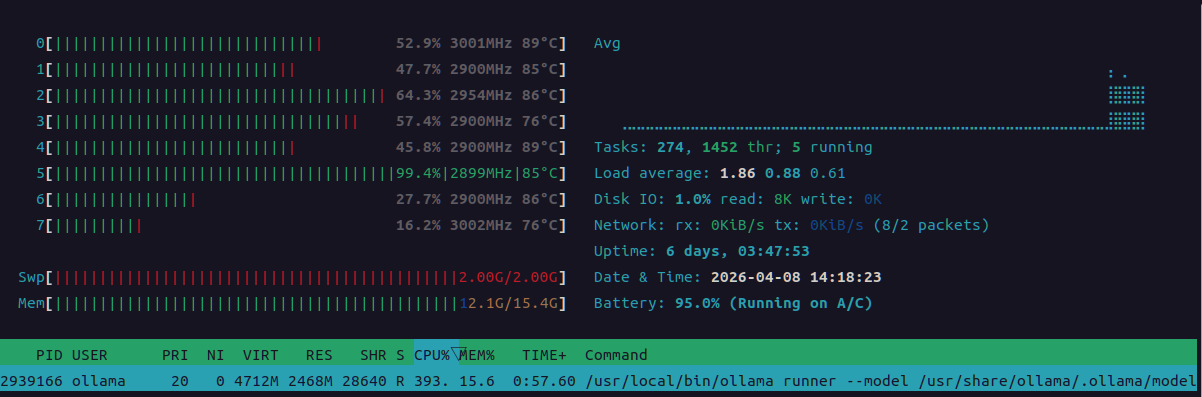
으아아 컴퓨터 녹는다 ㅋㅋㅋ
그래도 초당 2~3 단어 정도 나오는 느낌인데 이정도만 해도 그냥 대화하는 느낌 속도라
그거보다 빠르면 읽기도 전에 말이 더 빠르게 나올 듯?
Intel(R) Core(TM) i7-10510U CPU @ 1.80GHz
다시 실행하니 내가 받아둔 모델이 뜬다.
| $ ollama Select model to run: Type to filter... Recommended gemma4 Reasoning and code generation locally, ~16GB, (not downloaded) qwen3.5 Reasoning, coding, and visual understanding locally, ~11GB, (not downloaded) kimi-k2.5:cloud Multimodal reasoning with subagents qwen3.5:cloud Reasoning, coding, and agentic tool use with vision glm-5:cloud Reasoning and code generation minimax-m2.7:cloud Fast, efficient coding and real-world productivity More ▸ llama3.2 ↑/↓ navigate • enter select • ← back |
| $ ollama --help Large language model runner Usage: ollama [flags] ollama [command] Available Commands: serve Start Ollama create Create a model show Show information for a model run Run a model stop Stop a running model pull Pull a model from a registry push Push a model to a registry signin Sign in to ollama.com signout Sign out from ollama.com list List models ps List running models cp Copy a model rm Remove a model launch Launch the Ollama menu or an integration help Help about any command Flags: -h, --help help for ollama --nowordwrap Don't wrap words to the next line automatically --verbose Show timings for response -v, --version Show version information Use "ollama [command] --help" for more information about a command. |
단발성으로 질문하고 속도를 보려고 하는데
음.. eval rate가 실제 체감되는 속도인가? 12 token/s
이정도 수치는 되어야 많이 지루하지 않게 읽는 속도로 말이 생성되는 듯.
| $ ollama run llama3.2:latest "안녕" --verbose 안녕하세요! (Hello!) I'm here to help you. How can I assist you today? total duration: 2.282485591s load duration: 143.825937ms prompt eval count: 27 token(s) prompt eval duration: 350.162008ms prompt eval rate: 77.11 tokens/s eval count: 21 token(s) eval duration: 1.73838491s eval rate: 12.08 tokens/s |
gemma가 핫하긴 한데 용량이 커서 안돌것 같아서 3로 시도
[링크 : https://ollama.com/library/gemma3]
[링크 : https://ollama.com/library/gemma4]
제법 빠르고llama 보다는 괜찮은듯?
| $ ollama run gemma3:1b --verbose >>> 안녕? 안녕하세요! 잘 지내세요? 😊 저는 오늘 당신의 도움이 필요하신 건가요? 궁금한 게 있으신가요? total duration: 1.695837878s load duration: 297.67234ms prompt eval count: 12 token(s) prompt eval duration: 164.822603ms prompt eval rate: 72.81 tokens/s eval count: 28 token(s) eval duration: 1.132524529s eval rate: 24.72 tokens/s |
혹시나 gemma4를 16GB 메모리에서 시도해봤는데 메모리 부족으로 실패.
| $ ollama run gemma4:e2b --verbose pulling manifest pulling 4e30e2665218: 100% ▕██████████████████▏ 7.2 GB pulling 7339fa418c9a: 100% ▕██████████████████▏ 11 KB pulling 56380ca2ab89: 100% ▕██████████████████▏ 42 B pulling c6bc3775a3fa: 100% ▕██████████████████▏ 473 B verifying sha256 digest writing manifest success Error: 500 Internal Server Error: model requires more system memory (7.3 GiB) than is available (4.8 GiB) |
프로세스 이것저것 죽이고 다시 시도하니 10token /s 정도 나오는 듯.
| $ ollama run gemma4:e2b --verbose >>> 안녕 안녕하세요! 😊 total duration: 1.261211464s load duration: 302.800476ms prompt eval count: 17 token(s) prompt eval duration: 551.024817ms prompt eval rate: 30.85 tokens/s eval count: 4 token(s) eval duration: 226.924038ms eval rate: 17.63 tokens/s >>> 너에 대해서 소개해봐 Thinking... Thinking Process: 1. **Analyze the Request:** The user asked "너에 대해서 소개해봐" (Tell me about yourself). 2. **Determine Identity & Core Facts (Self-Correction/Verification):** * Name: Gemma 4. * Developer: Google DeepMind. * Nature: Large Language Model (LLM). * Type: Open weights model. * Capabilities: Understands text/images, generates text. * Knowledge Cutoff: (Relevant for context, but usually stated implicitly) 3. **Structure the Introduction (Korean Context):** A good introduction should cover: * Greeting. * Name/Identity. * Developer/Origin. * Nature/Function (What I do). * Capabilities (What I can process). 4. **Draft the Response (Internal Monologue & Refinement):** * *Start warmly.* (안녕하세요!) * *State Identity.* (저는 Gemma 4입니다.) * *State Origin.* (Google DeepMind에서 개발했습니다.) * *State Nature.* (저는 대규모 언어 모델(LLM)입니다.) * *State Function/Role.* (사용자의 질문에 답하고, 정보를 제공하며, 다 양한 텍스트 기반 작업을 돕는 역할을 합니다.) * *State Modality/Input.* (텍스트와 이미지를 이해할 수 있습니다.) * *Concluding remark/Offer help.* (어떤 것을 도와드릴까요?) 5. **Final Output Generation (Review against constraints):** The generated response must adhere to the core identity (Gemma 4, LLM, Google DeepMind, open weights). (The draft looks good and adheres to the required identity.) ...done thinking. 안녕하세요! 저는 **Gemma 4**입니다. 저는 Google DeepMind에서 개발한 **대규모 언어 모델(LLM)**이며, 오픈 웨이트 (open weights) 모델로 공개되어 있습니다. **저의 주요 특징은 다음과 같습니다:** 1. **정체성:** 저는 방대한 데이터를 학습하여 인간의 언어를 이해하고 생성하며 , 다양한 질문에 답하고 정보를 제공하는 능력을 가지고 있습니다. 2. **기능:** 텍스트 기반의 대화, 요약, 번역, 작문, 코드 생성 등 다양한 언어 관련 작업을 수행할 수 있습니다. 3. **입력 능력:** 저는 텍스트와 이미지를 이해하고 처리할 수 있습니다. (다만 , 출력은 텍스트로만 생성합니다.) 4. **목표:** 사용자분들이 필요한 정보를 얻고, 창의적인 작업을 수행하며, 복잡 한 문제를 해결하는 데 도움을 드릴 수 있도록 설계되었습니다. 궁금한 점이 있거나 도움이 필요하시면 언제든지 말씀해주세요! 😊 total duration: 57.596689687s load duration: 297.105521ms prompt eval count: 35 token(s) prompt eval duration: 482.722245ms prompt eval rate: 72.51 tokens/s eval count: 614 token(s) eval duration: 56.261795129s eval rate: 10.91 tokens/s |
+
intel 내장 그래픽(xe 나 arc 아님)은 openCL 가속 자체를 지원하지 않나?
| $ clinfo Number of platforms 0 |
[링크 : https://docs.ollama.com/gpu]
[링크 : https://dgpu-docs.intel.com/driver/client/overview.html#ubuntu-22.04]
| python + telegram + ollama + selenium (0) | 2026.04.09 |
|---|---|
| python 으로 telegram + fatherbot 연동하기 (0) | 2026.04.08 |
| antigravity artifact (0) | 2026.03.18 |
| gemini 동영상 만들기 (유료?) (0) | 2026.02.22 |
| antigravity 사용량 끝! (0) | 2026.02.20 |
음.. cp로 하니 이상하게 안되는 군
| $ nvcc tt.cpp tt.cpp: In function ‘void kernel_test(int*, int*, int*)’: tt.cpp:14:12: error: ‘threadIdx’ was not declared in this scope int idx = threadIdx.x +blockIdx.x * blockDim.x + (gridDim.x * blockDim.x) * (blockIdx.y * blockDim.y + threadIdx.y); ^~~~~~~~~ tt.cpp:14:12: note: suggested alternative: ‘pthread_t’ int idx = threadIdx.x +blockIdx.x * blockDim.x + (gridDim.x * blockDim.x) * (blockIdx.y * blockDim.y + threadIdx.y); ^~~~~~~~~ pthread_t tt.cpp:14:25: error: ‘blockIdx’ was not declared in this scope int idx = threadIdx.x +blockIdx.x * blockDim.x + (gridDim.x * blockDim.x) * (blockIdx.y * blockDim.y + threadIdx.y); ^~~~~~~~ tt.cpp:14:25: note: suggested alternative: ‘clock’ int idx = threadIdx.x +blockIdx.x * blockDim.x + (gridDim.x * blockDim.x) * (blockIdx.y * blockDim.y + threadIdx.y); ^~~~~~~~ clock tt.cpp:14:38: error: ‘blockDim’ was not declared in this scope int idx = threadIdx.x +blockIdx.x * blockDim.x + (gridDim.x * blockDim.x) * (blockIdx.y * blockDim.y + threadIdx.y); ^~~~~~~~ tt.cpp:14:38: note: suggested alternative: ‘clock’ int idx = threadIdx.x +blockIdx.x * blockDim.x + (gridDim.x * blockDim.x) * (blockIdx.y * blockDim.y + threadIdx.y); ^~~~~~~~ clock tt.cpp:14:52: error: ‘gridDim’ was not declared in this scope int idx = threadIdx.x +blockIdx.x * blockDim.x + (gridDim.x * blockDim.x) * (blockIdx.y * blockDim.y + threadIdx.y); ^~~~~~~ tt.cpp: At global scope: tt.cpp:18:11: error: ‘::main’ must return ‘int’ void main() ^ tt.cpp: In function ‘int main()’: tt.cpp:61:15: error: expected primary-expression before ‘<’ token kernel_test<<<block,thread>>>(dev_a,dev_b,dev_c); ^ tt.cpp:61:30: error: expected primary-expression before ‘>’ token kernel_test<<<block,thread>>>(dev_a,dev_b,dev_c); ^ |
음.. cuda는 main이 int 형이여야 하는군
| $ nvcc tt.cu tt.cu(18): warning: return type of function "main" must be "int" tt.cu(18): warning: return type of function "main" must be "int" tt.cu:18:11: error: ‘::main’ must return ‘int’ void main() ^ |
[링크 : https://mangkyu.tistory.com/84]
싱글코어
| $ ./a.out cpu Time : 0.206937 gpu Time : 0.000106 |
어..? 멀티코어 돌리는게 왜 더 느려?!?!
| $ nvcc -Xcompiler -fopenmp tt.cu -o a.out.mp jetson@nano-4gb-jp451:~$ ./a.out.mp cpu Time : 0.231175 gpu Time : 0.000088 |
[링크 : https://forums.developer.nvidia.com/t/how-use-openmp-in-cu-file/2918/10]
2014.01.17 - [Programming/openCL & CUDA] - cuda + openmp 적용 예제
| jetson nano devloper kit SD card image(A02) (0) | 2026.07.20 |
|---|---|
| jetracer donkey car (0) | 2026.04.20 |
| jetson nvcc 실행하기 (0) | 2026.04.06 |
| jetson nano 2gb dev kit EOL 근접 (0) | 2026.04.05 |
| jetracer에 사용할 보호회로 없는 배터리 구매 (2) | 2026.04.04 |
그냥 해보니 없는데 경로 따라가니 있다. 오호
| jetson@nano-4gb-jp451:~$ nvcc -bash: nvcc: command not found jetson@nano-4gb-jp451:~$ /usr/local/cuda-10.2/bin/nvcc nvcc fatal : No input files specified; use option --help for more information |
cuda로 심볼릭 링크되어있으니 이걸로 하면 편할듯
| /usr/local$ ls -al total 48 drwxr-xr-x 12 root root 4096 May 26 2021 . drwxr-xr-x 12 root root 4096 Feb 19 2021 .. drwxr-xr-x 3 root root 4096 Mar 30 07:22 bin lrwxrwxrwx 1 root root 9 Feb 19 2021 cuda -> cuda-10.2 drwxr-xr-x 12 root root 4096 Feb 19 2021 cuda-10.2 drwxr-xr-x 3 root root 4096 May 26 2021 etc drwxr-xr-x 2 root root 4096 Apr 26 2018 games drwxr-xr-x 2 root root 4096 Apr 26 2018 include drwxr-xr-x 2 root root 4096 May 26 2021 jetson_stats drwxr-xr-x 4 root root 4096 Jun 4 2018 lib lrwxrwxrwx 1 root root 9 Apr 26 2018 man -> share/man drwxr-xr-x 2 root root 4096 Apr 26 2018 sbin drwxr-xr-x 11 root root 4096 May 26 2021 share drwxr-xr-x 2 root root 4096 Apr 26 2018 src |
| $ tail -2 ~/.bashrc export PATH=/usr/local/cuda/bin${PATH:+:${PATH}}$ export LD_LIBRARY_PATH=/usr/local/cuda/lib64${LD_LIBRARY_PATH:+:${LD_LIBRARY_PATH}} |
| jetracer donkey car (0) | 2026.04.20 |
|---|---|
| jetson nano nvcc 빌드 (0) | 2026.04.06 |
| jetson nano 2gb dev kit EOL 근접 (0) | 2026.04.05 |
| jetracer에 사용할 보호회로 없는 배터리 구매 (2) | 2026.04.04 |
| jetracer ina219 배터리 모니터링 ic (0) | 2026.04.04 |
hid multitouch 드라이버 보다가 신기한(?)거 발견
간단하게(?) /sys 경로에 show_mt 라는 파일이 생성되고 boolean 타입으로 내용을 써주면 드라이버에서
그 값을 이용해 작동하게 되는 매크로.
| module_param(show_mt, bool, 0444); |
[링크 : https://github.com/bentiss/hid-multitouch/blob/master/hid-multitouch.c]
| openpty, forkpty, login_tty (0) | 2026.09.09 |
|---|---|
| 커널 cmdline 관련 함수 (0) | 2026.04.03 |
| kernel input_event() (1) | 2025.12.23 |
| linux 시리얼 포트 열기(termios) (0) | 2025.10.11 |
| LD_DEBUG=libs (0) | 2025.06.02 |

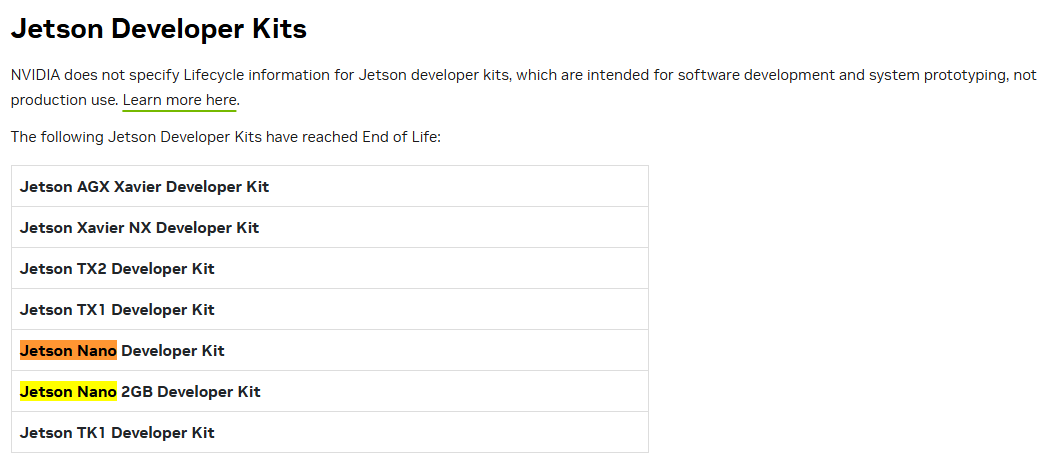
양산품은 2027년

구버전 개발킷도 이제는 단종 시키려고 하는듯.
명시하진 않았으나 도달중인.. 표현이 참..
| jetson nano nvcc 빌드 (0) | 2026.04.06 |
|---|---|
| jetson nvcc 실행하기 (0) | 2026.04.06 |
| jetracer에 사용할 보호회로 없는 배터리 구매 (2) | 2026.04.04 |
| jetracer ina219 배터리 모니터링 ic (0) | 2026.04.04 |
| jetracer interactive-regression (1) | 2026.04.04 |
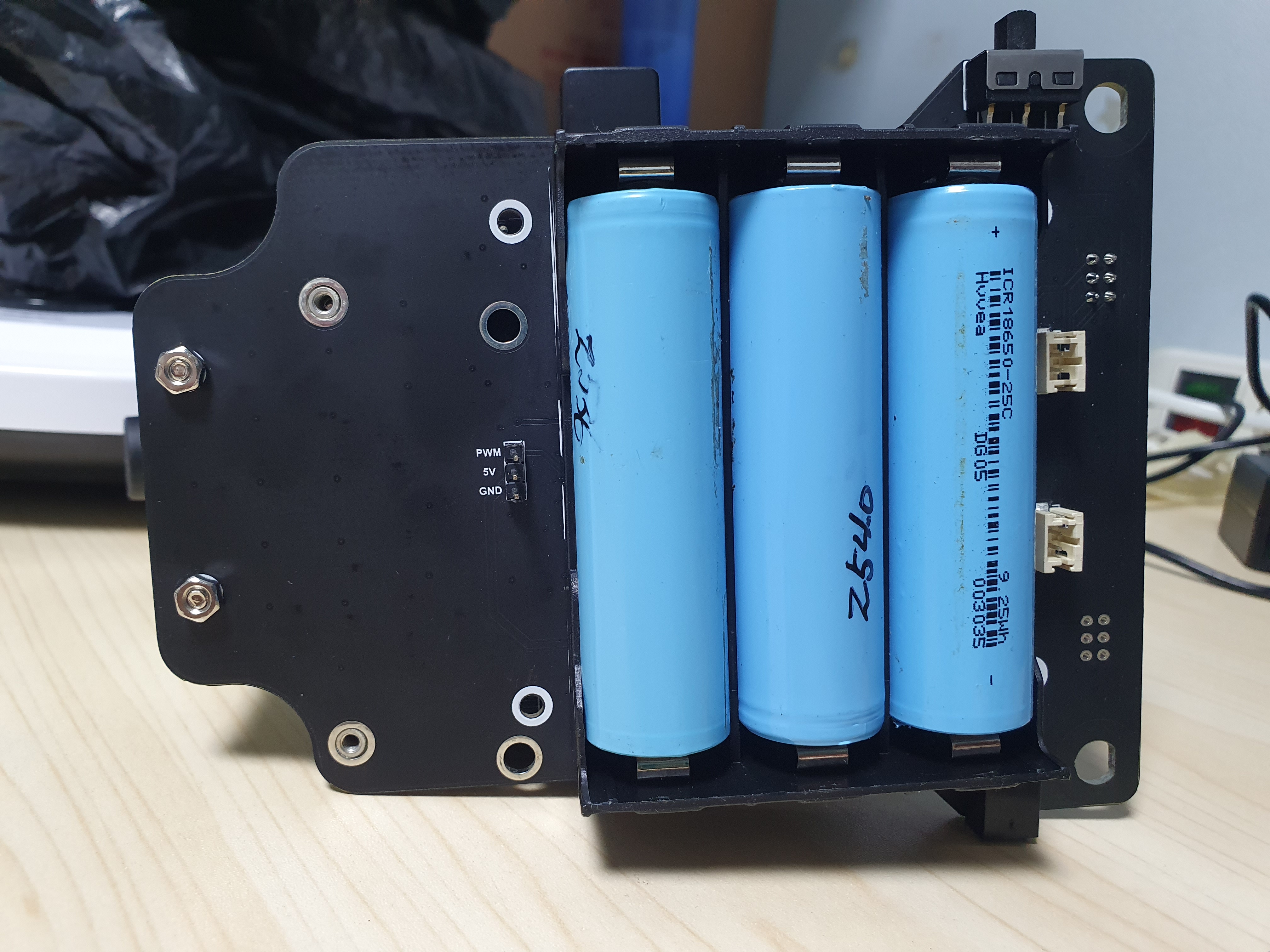
중고로 3개 구매함(개당 2500원, 당근 99도!)
인터넷으로 보호회로 없는걸 사기 힘드니까 어쩔수 없긴한데
아무튼 깔끔하게 조립이 가능해져서 행복 +_+
그 와중에 모니터링 하고 싶은데 영 방법이 안보이네
7:10 부터 9:00 까지 전진 계속 시키고 jetson 켜놨는데
뺴고 재보니 3.9V 나오는걸 봐서는 3시간 정도 어찌 버틸듯?
사양만 보면 25C 고방전 사양의 배터리인가?!
| jetson nvcc 실행하기 (0) | 2026.04.06 |
|---|---|
| jetson nano 2gb dev kit EOL 근접 (0) | 2026.04.05 |
| jetracer ina219 배터리 모니터링 ic (0) | 2026.04.04 |
| jetracer interactive-regression (1) | 2026.04.04 |
| imx219-160 (0) | 2026.04.03 |
있다는데 어떻게 읽지?
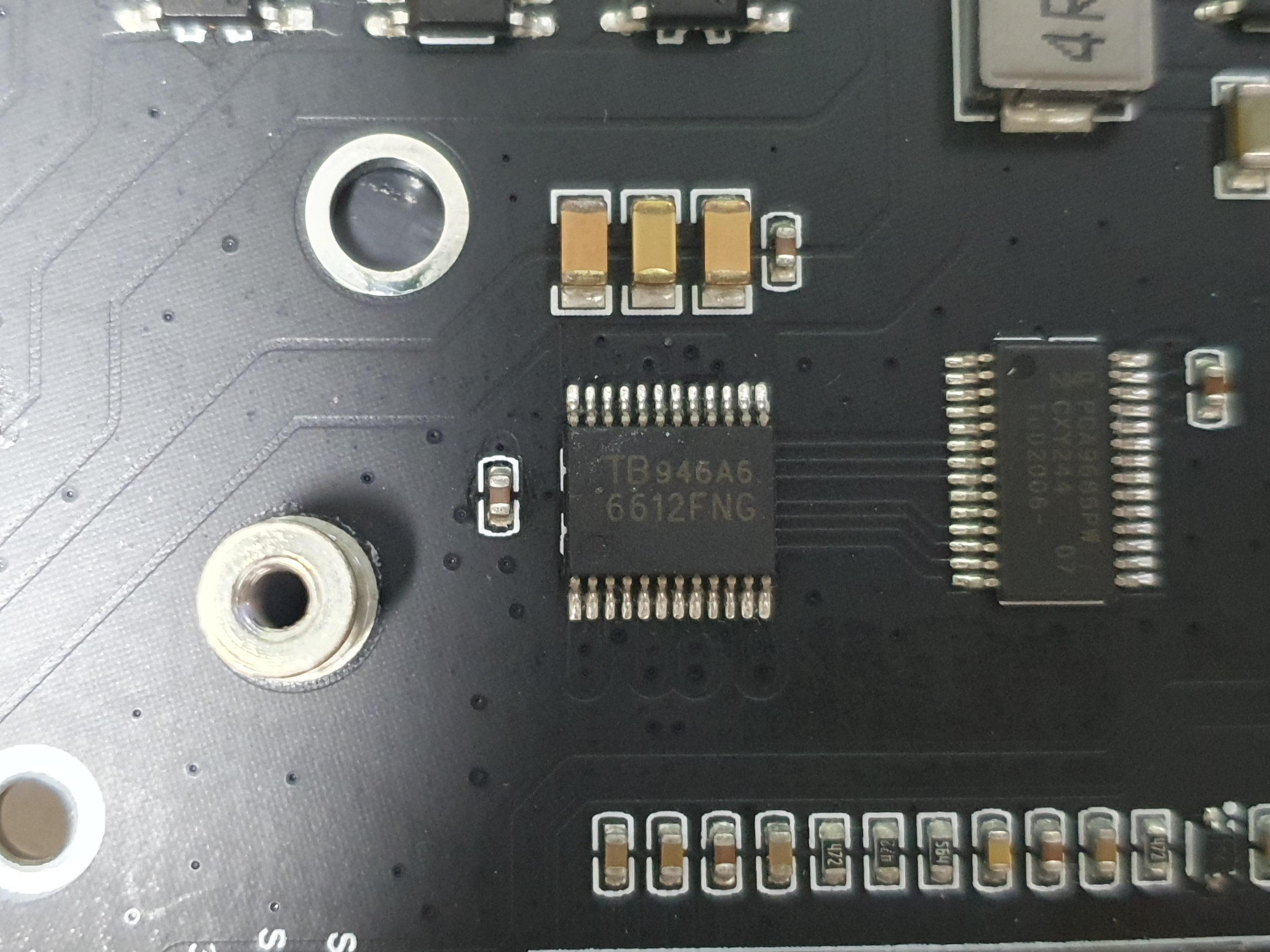
| Features Support three 18650 batteries (not included), 7800mAh large capacity, up to 12.6V output, stronger motor power. On-board S-8254AA + AO4407A Li-ion battery protection circuit, with anti-overcharge, anti-over-discharge, anti-over-current and short-circuit protection functions. Onboard APW7313 voltage regulator chip, which can provide stable 5V voltage to Jetson Nano. Onboard TB6612FNG dual H-bridge motor driver chip can drive the left and right two motor work. Onboard 0.91" 128×32 resolution OLED, real-time display of car IP address, memory, power, and other conditions. Onboard INA219 acquisition chip, convenient for real-time monitoring of battery voltage. Datasheet Ina219 PCA96_datasheet S-8254AA Ads1115 TB6612FNG |
[링크 : https://www.waveshare.com/wiki/JetRacer_AI_Kit]
근데 회로도에 없다 -_-?
회로도에는 대신이라고 하긴 뭣하지만 ads1115가 존재한다.
[링크 : https://files.waveshare.com/upload/4/4a/JetRacer_Schematic.pdf]
그냥 검색하면 안나오는데
| jetson@nano-4gb-jp451:~ $ i2cdetect -y 1 Warning: Can't use SMBus Quick Write command, will skip some addresses 0 1 2 3 4 5 6 7 8 9 a b c d e f 00: 10: 20: 30: -- -- -- -- -- -- -- -- 40: 50: -- -- -- -- -- -- -- -- -- -- -- -- -- -- -- -- 60: 70: |
-r 주면 smbus 무시하고 하는건지 먼가 나오긴한다. 그런데.. 누가 ina219고 누가 ads1115냐..
| jetson@nano-4gb-jp451:~$ i2cdetect -y -r 1 0 1 2 3 4 5 6 7 8 9 a b c d e f 00: -- -- -- -- -- 08 -- -- -- -- -- -- -- 10: -- -- -- -- -- -- -- -- -- -- -- -- -- -- -- -- 20: -- -- -- -- -- -- -- -- -- -- -- -- -- -- -- -- 30: -- -- -- -- -- -- -- -- -- -- -- -- 3c -- -- -- 40: 40 41 -- -- -- -- -- -- -- -- -- -- -- -- -- -- 50: -- -- -- -- -- -- -- -- -- -- -- -- -- -- -- -- 60: 60 -- -- -- -- -- -- -- -- -- -- -- -- -- -- -- 70: -- 71 -- -- -- -- -- -- |
ADS1115 - 0x4A, 0x4B, 0x48, 0x49 라고 검색되는데 안보이고..
INA219 - 0x40, 0x41, 0x44, 0x45 라는데 일단 0x40과 0x41이 보이긴한다.
APW7313 - voltage regulator
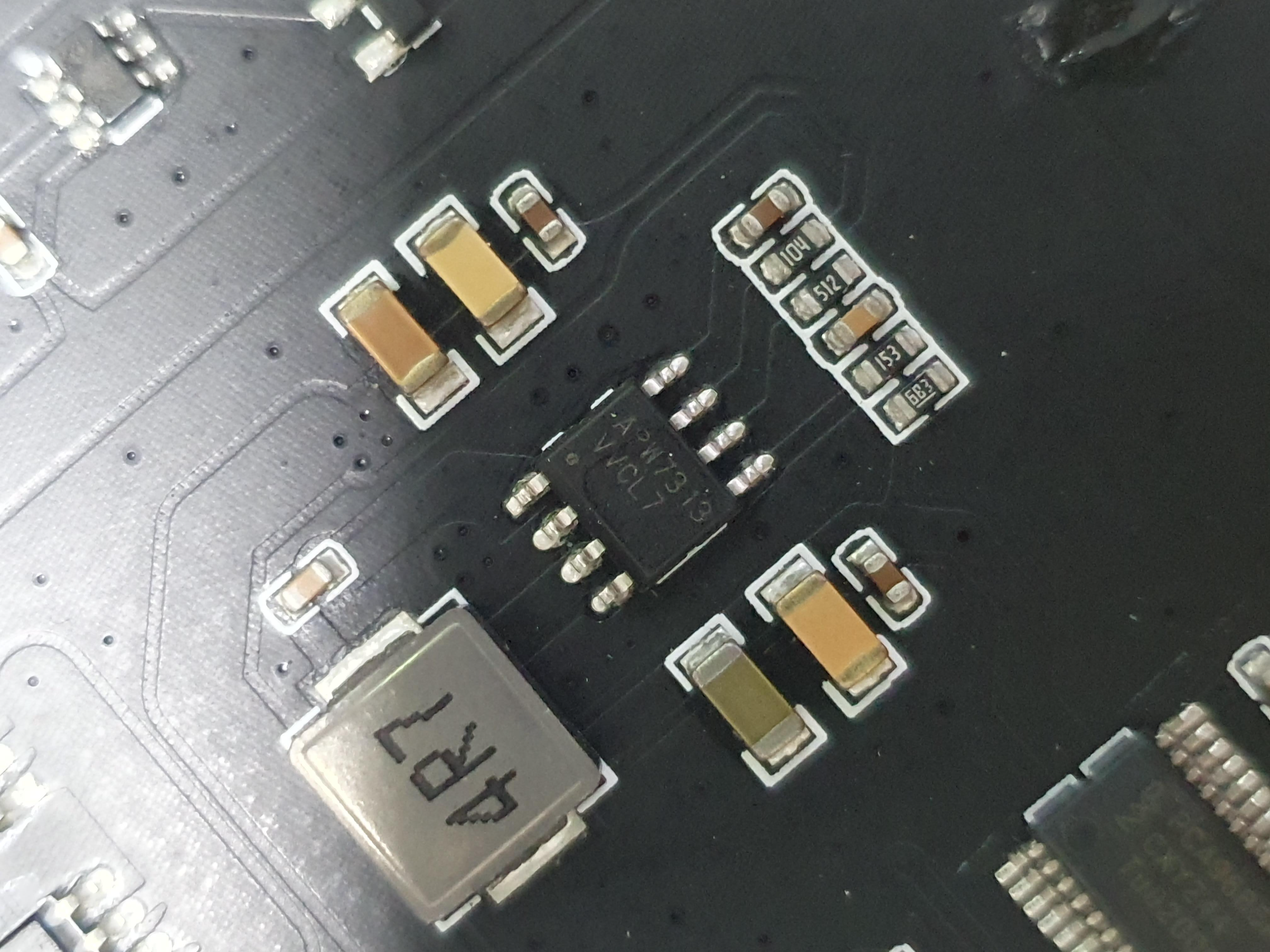
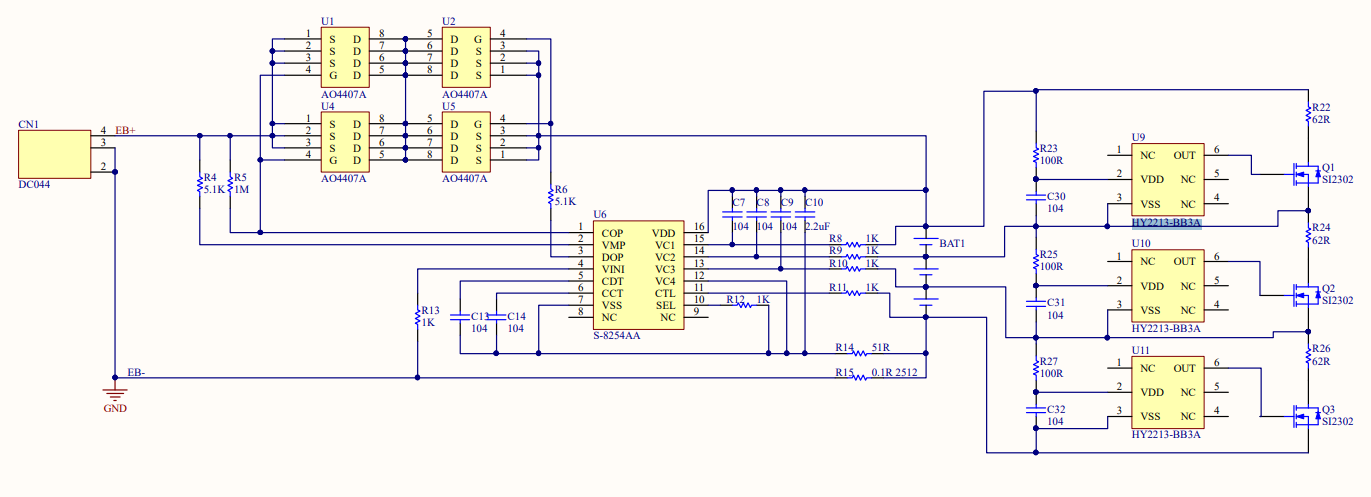
S-8254AA + AO4407A * 3 배터리 보호회로
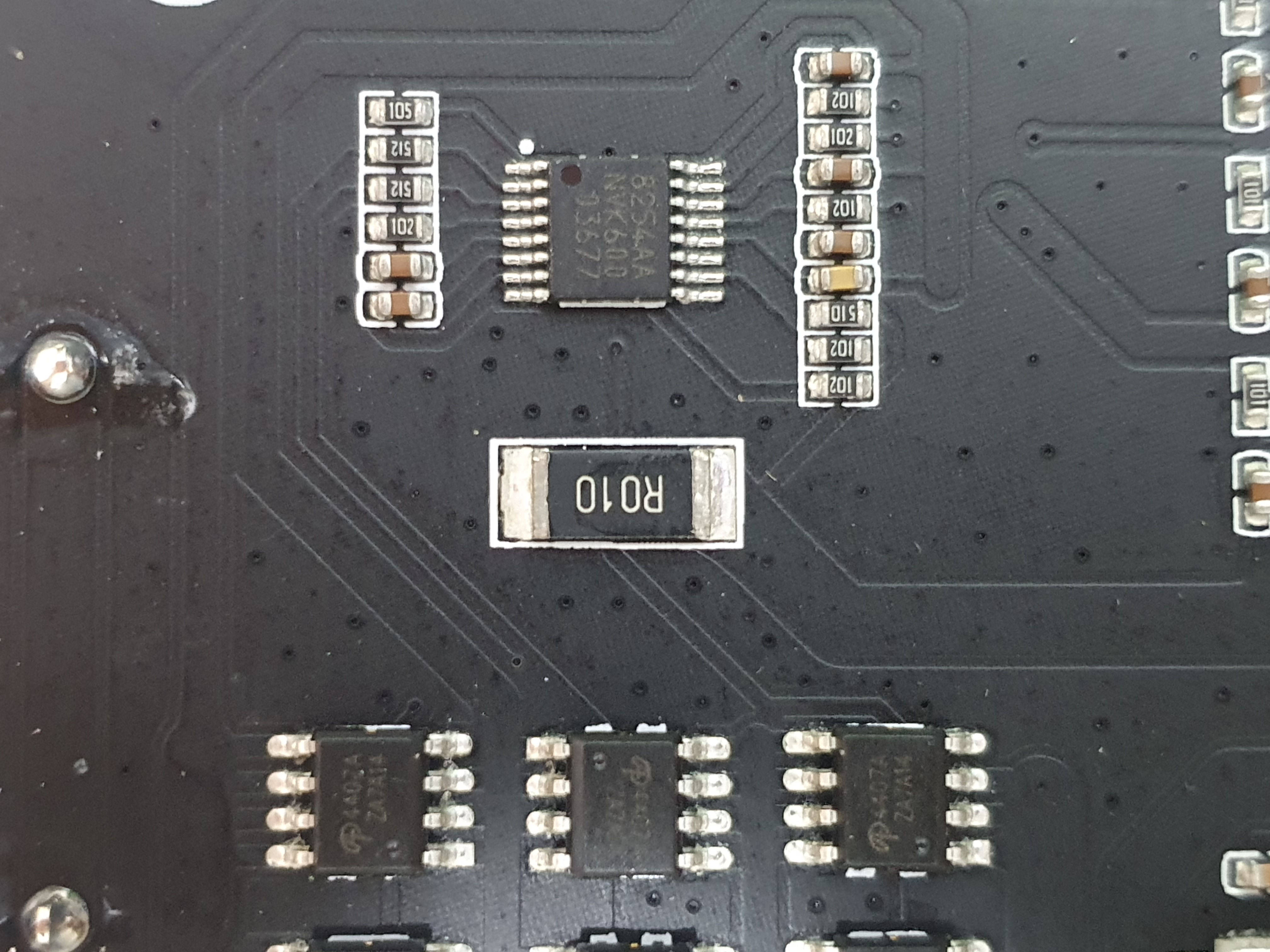
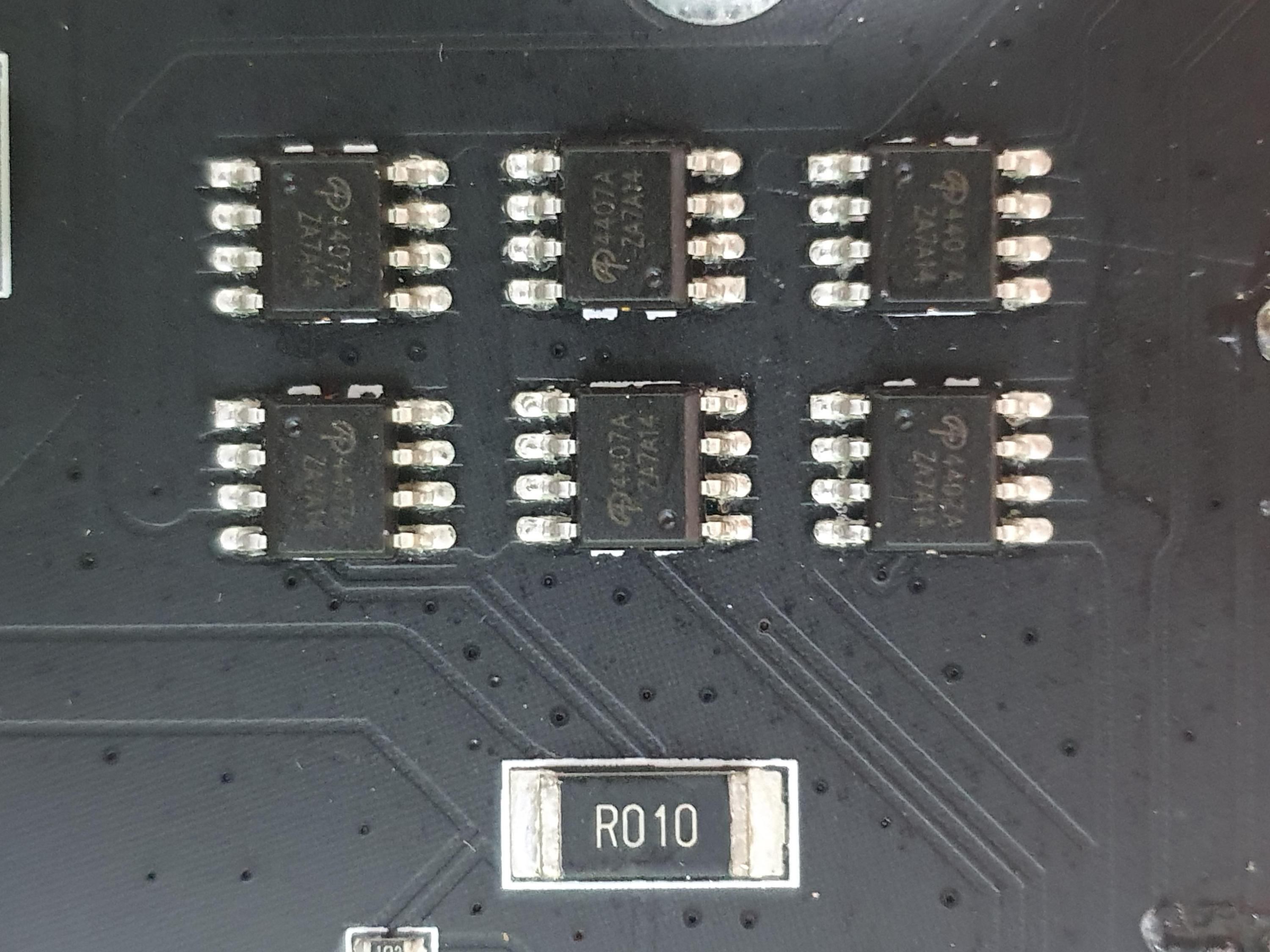
근데 회로도상으로는 4407에 붙은 10mohm도 없고 4개여야 하는데 6개나 있다. 멀까?
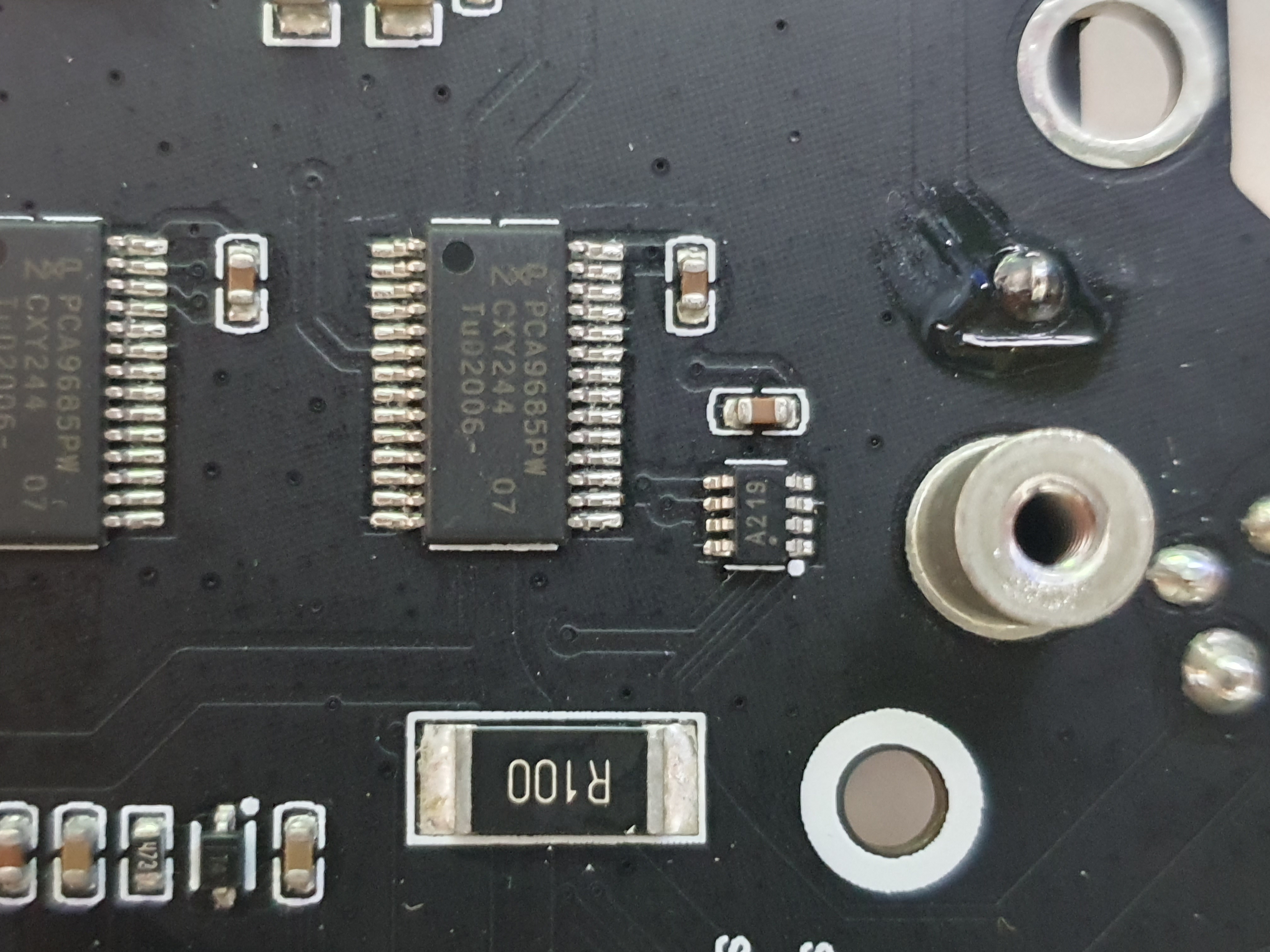
NXP PCA9685 - 16ch 12bit PWM
ina219 에 100밀리옴인가?
TB6612FNG - Driver IC for Dual DC motor
+
gpt로 대충 작성
| $ cat in.py import board import busio from adafruit_ina219 import INA219 import time # I2C i2c = busio.I2C(board.SCL, board.SDA) # 주소 (Waveshare는 0x42인 경우 많음) ina219 = INA219(i2c, addr=0x41) # R100 = 0.1Ω 설정 (중요) ina219.shunt_resistance = 0.1 while True: print(f"Voltage: {ina219.bus_voltage:.3f} V") print(f"Current: {ina219.current:.3f} mA") print(f"Power: {ina219.power:.3f} mW") print("------") time.sleep(1) |
충전 중에는 12.6V가 맞는것 같은데
선을 뽑으면 current가 0으로 떨어진다. 젯슨 나노가 쓰는게 있으니 음수 전류가 나와야 할 것 같은데
충전만 모니터링하고 방전은 안하는걸려나?
일단 수치상으로는 power는 mW가 아니라 W 일 듯?
| $ python3 in.py Voltage: 12.608 V Current: 379.400 mA Power: 4.962 mW ------ Voltage: 12.616 V Current: 374.700 mA Power: 4.752 mW ------ Voltage: 12.616 V Current: 358.400 mA Power: 4.542 mW ------ Voltage: 12.620 V Current: 356.100 mA Power: 4.890 mW ------ Voltage: 12.512 V Current: 0.000 mA Power: 0.000 mW ------ Voltage: 12.512 V Current: -0.200 mA Power: 0.004 mW ------ Voltage: 12.520 V Current: 0.100 mA Power: 0.000 mW ------ Voltage: 12.516 V Current: -0.100 mA Power: 0.000 mW ------ Voltage: 12.496 V Current: 0.100 mA Power: 0.000 mW |
| jetson nano 2gb dev kit EOL 근접 (0) | 2026.04.05 |
|---|---|
| jetracer에 사용할 보호회로 없는 배터리 구매 (2) | 2026.04.04 |
| jetracer interactive-regression (1) | 2026.04.04 |
| imx219-160 (0) | 2026.04.03 |
| jetracer 조립 거의 완료 (0) | 2026.04.01 |
Data Collection 에서 사진을 찍는데
일단~~~은 dataset A / B, 두 가지가 존재하니 두 개 객체에 대해서 일단 각각 찍어 본다.
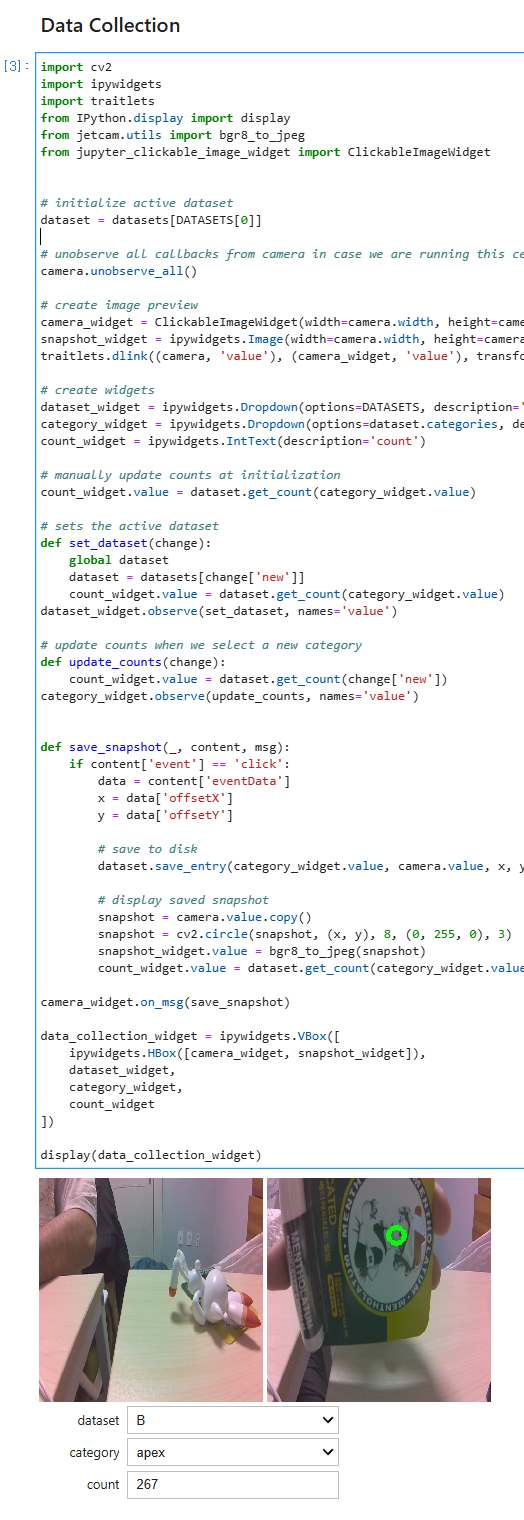
그리고 실제 학습은 저~~~기 아래 14번 BATCH_SIZE 있는데서 이뤄진다.
resnet18이긴 하지만 엣지에서 바로 학습이라니 정말 젯슨 나노가 그당시 파워풀했구나..
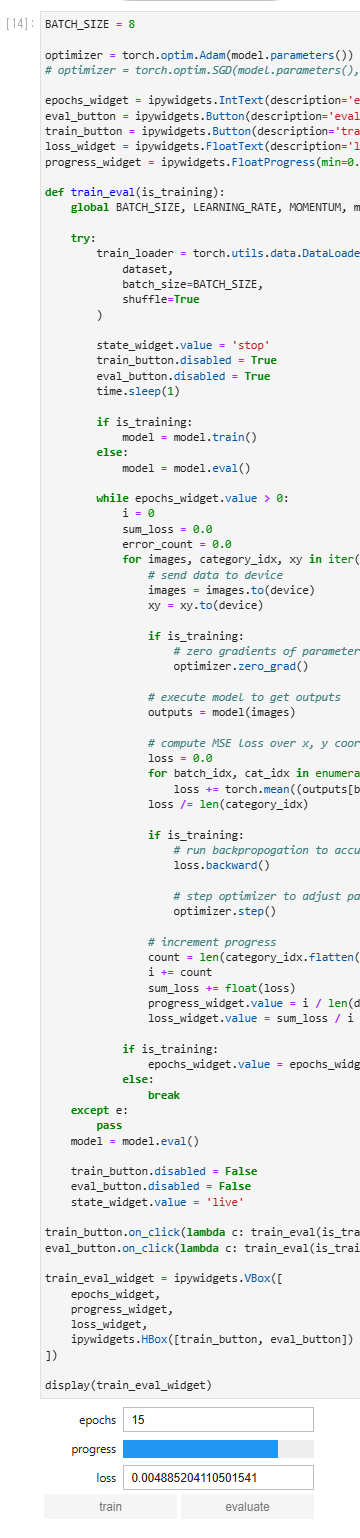
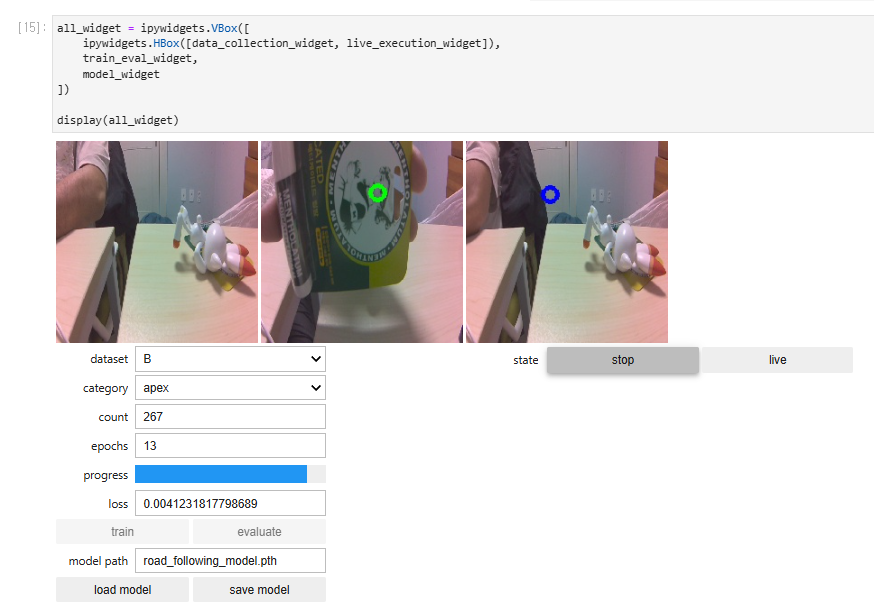
epoch를 10 주고 돌리고 나서 가장 아래의 15번째 항목에서 state live로 하고 카메라로 저장했던 객체를 들이대면
조금 따라가는 느낌이 나긴한다. 그러면 다시 위에가서 학습하고 반복
| jetracer에 사용할 보호회로 없는 배터리 구매 (2) | 2026.04.04 |
|---|---|
| jetracer ina219 배터리 모니터링 ic (0) | 2026.04.04 |
| imx219-160 (0) | 2026.04.03 |
| jetracer 조립 거의 완료 (0) | 2026.04.01 |
| jetson nano 조이스틱 연결 (0) | 2026.03.31 |

|


