Can be used to pad other options so that they are aligned to the word boundary; is not followed by length byte
1
Subnet mask
4 octets
Client's subnet mask as perRFC 950. If both the subnet mask and the router option (option 3) are included, the subnet mask option must be first.
2
Time offset
4 octets
Time offset of the client's subnet in seconds from Coordinated Universal Time (UTC). The offset is expressed as a two's complement 32-bit integer. A positive offset indicates a location east of the zero meridian and a negative offset indicates a location west of the zero meridian.
3
Router
Multiples of 4 octets
Available routers, should be listed in order of preference
4
Time server
Multiples of 4 octets
AvailableTime Protocolservers to synchronise with, should be listed in order of preference
5
Name server
Multiples of 4 octets
AvailableIEN 116name servers, should be listed in order of preference
6
Domain name server
Multiples of 4 octets
AvailableDNSservers, should be listed in order of preference
7
Log server
Multiples of 4 octets
Available log servers, should be listed in order of preference
8
Cookie server
Multiples of 4 octets
Cookiein this case means "fortune cookie" or "quote of the day", a pithy or humorous anecdote often sent as part of a logon process on large computers; it has nothing to do withcookies sent by websites.
This appendix contains DHCP options and BOOTP vendor extensions from RFC 2132, and includes the validation type for each option, as indicated in Table 10: DHCPv4 Options by Number , on page 23.
The following sections describe the DHCP options in detail: • RFC 1497 Vendor Extensions, on page 1
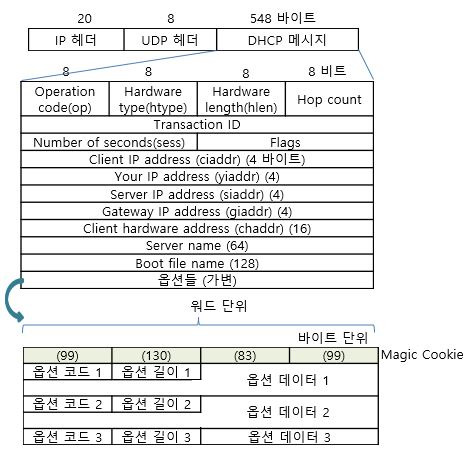
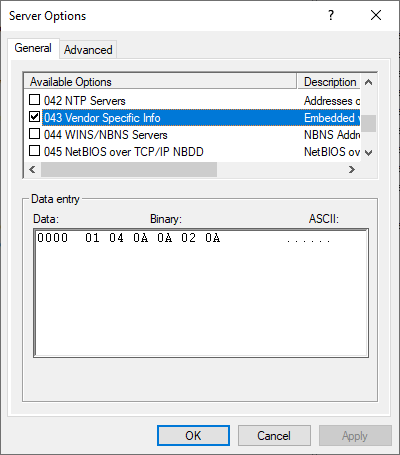
DHCP option 43 / 25DHCP (Dynamic Host Configuration Protocol) 에는 클라이언트가 DHCP 서버로부터 정보를 요청할 때 클라이언트에게 송신할 수 있는 많은 구성 옵션이 있습니다. 검색 도구를 사용하여 모든 DHCP 옵션을 볼 수 있습니다.
DHCP 옵션은 DHCP 서버가 IP 주소와 함께 클라이언트에게 전달하는 추가적인 구성 데이터를 정의합니다. 일반적인 옵션에는 서브네트 마스크, 도메인명, 라우터 IP 주소, 도메인명 서버 IP 주소 및 정적 라우트가 포함됩니다.
RFC 2132: DHCP 옵션 및 BOOTP 공급업체 확장의 정의를 기반으로 하는 표준 DHCP 옵션이 다음 표에 설명되어 있습니다. IBM Navigator FOR I의 DHCP 옵션 표시를 사용하여 사용자 지정 옵션을 구성할 수도 있습니다.
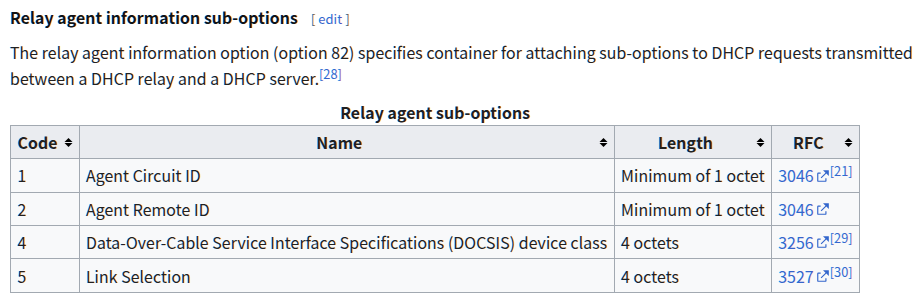
하나만 설정하면 되는게 아니라 4개의 옵션이 다 설정되어야 DHCP option 82 relay 가 적용되나 보다.
option agent.circuit-id string;
The circuit-id suboption encodes an agent-local identifier of the circuit from which a DHCP client-to- server packet was received. It is intended for use by agents in relaying DHCP responses back to the proper circuit. The format of this option is currently defined to be vendor-dependent, and will probably remain that way, although the current draft allows for the possibility of standardizing the format in the future.
option agent.remote-id string;
The remote-id suboption encodes information about the remote host end of a circuit. Examples of what it might contain include caller ID information, username information, remote ATM address, cable modem ID, and similar things. In principal, the meaning is not well-specified, and it should generally be assumed to be an opaque object that is administratively guaranteed to be unique to a particular remote end of a circuit.
option agent.DOCSIS-device-class uint32;
The DOCSIS-device-class suboption is intended to convey information about the host endpoint, hardware, and software, that either the host operating system or the DHCP server may not otherwise be aware of (but the relay is able to distinguish). This is implemented as a 32-bit field (4 octets), each bit representing a flag describing the host in one of these ways. So far, only bit zero (being the least significant bit) is defined in RFC3256. If this bit is set to one, the host is considered a CPE Controlled Cable Modem (CCCM). All other bits are reserved.
option agent.link-selection ip-address;
The link-selection suboption is provided by relay agents to inform servers what subnet the client is actually attached to. This is useful in those cases where the giaddr (where responses must be sent to the relay agent) is not on the same subnet as the client. When this option is present in a packet from a relay agent, the DHCP server will use its contents to find a subnet declared in configuration, and from here take one step further backwards to any shared-network the subnet may be defined within; the client may be given any address within that shared network, as normally appropriate.